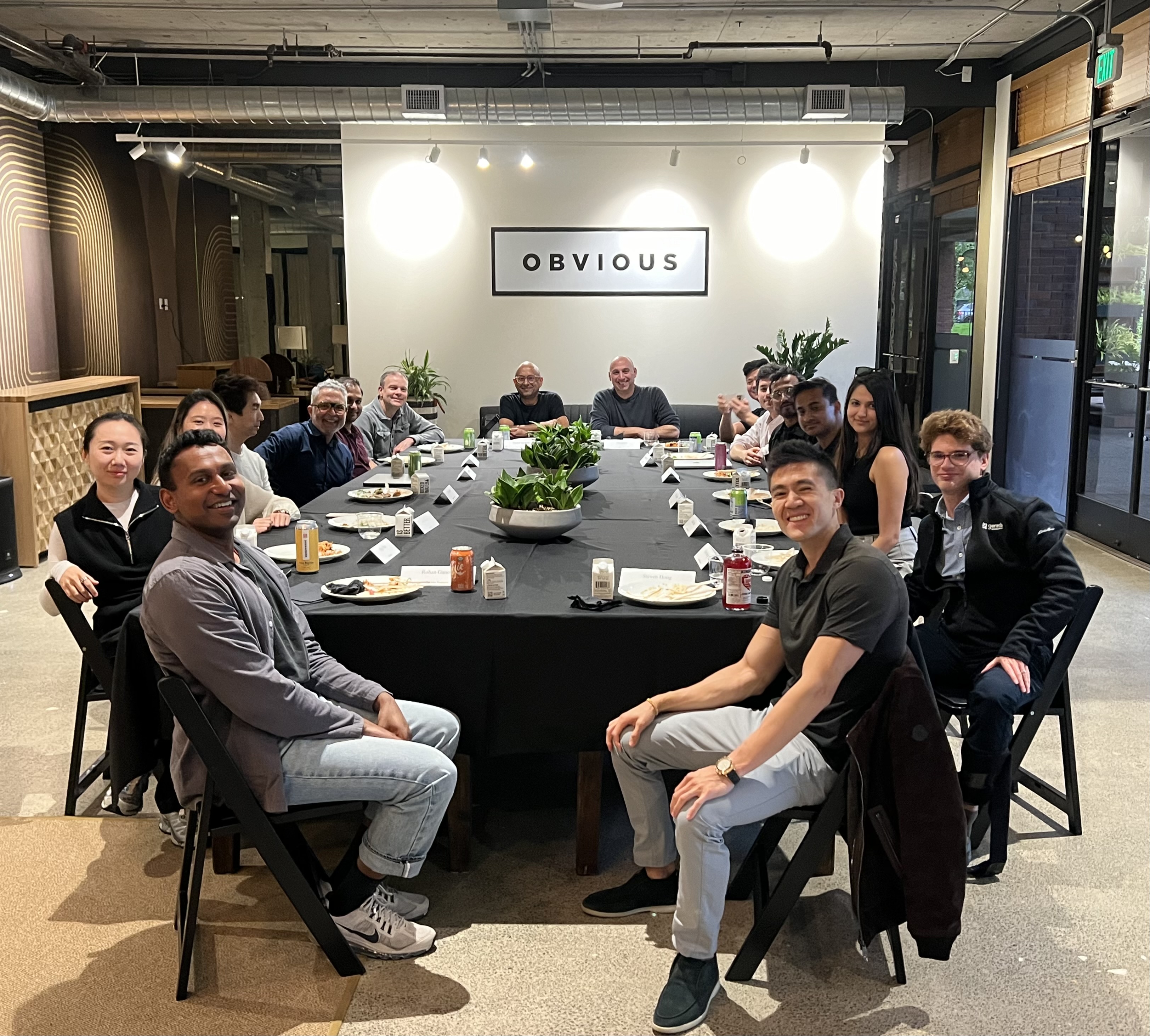
Last week, a group of founders, researchers, and investors: Joseph Spisak (VP @ Reflection AI), Evan Feinberg (CEO @ Genesis Molecular AI), Anuroop Sriram (Researcher @ Project Prometheus), Larry Zitnick (AI Research Director @ Meta FAIR), Steven Hong (Founder @ Stealth), Gege Wen (CEO @ Earth Flow AI), Eric Nguyen (CEO @ Radical Numerics), Vivek Adarsh (CEO @ Mithril), Amber Liu (Cofounder @ Stealth), etc. gathered for an intimate dinner - thank you Obvious Ventures team & Joe Spisak to help put this together - to explore a question that feels increasingly urgent:
What happens when AI leaves the world of code—and collides with the physical world of science?
The conversation spanned materials science, drug discovery, physics, and biology. But beneath the surface, a few clear themes emerged: feedback loops, business model reinvention, and a coming architectural shift beyond today’s AI systems.
From Code to Atoms: Why Science Is Different
AI has already transformed software. In coding, feedback loops are tight: you write code, run it, and get instant verification.
Science is the opposite.
In materials science, for example, verification can take days or weeks—and even then, results may not reproduce across labs. Two teams can attempt to create the same material and end up with entirely different outcomes. Characterization tools often only capture atomic percentages, not the actual structure or arrangement.
This creates a fundamental bottleneck:
AI is only as powerful as the feedback loop it operates in.
In fields like physics and math, the story is different. With centuries of governing equations—Navier-Stokes, conservation laws—researchers can generate effectively infinite synthetic data. These domains look more like software: simulation-rich, compute-driven, and fast-iterating.
Biology sits somewhere in between—but with a crucial twist:
it has strong IP protection and high-margin outcomes.
The Business Model Shift: From Tools to Full-Stack Companies
One of the clearest takeaways from the dinner:
Horizontal AI platforms for science are dying.
In materials science, this is especially stark:
- Patents are weak and easy to work around
- Most materials don’t support billion-dollar markets
- Reproducibility challenges slow everything down
Even worse, large-scale open-source efforts—like the release of massive DFT datasets—have collapsed the value of proprietary data advantages.
The result?
The only viable path is vertical integration.
Successful companies are no longer just “AI platforms.” They are:
- AI + domain expertise
- AI + proprietary data loops
- AI + manufacturing or deployment
In drug discovery, this model is already working:
- Pharma companies now view AI as asset generation, not cost reduction
- Deals with $30M–$100M+ upfront payments are becoming common
- Startups are building full pipelines: in silico discovery → IND filing → licensing
The lesson is clear:
Owning the outcome matters more than owning the model.
The End of the Horizontal Model Moat
Another strong consensus:
The model layer is rapidly commoditizing.
- Open-source models are advancing at unprecedented speed
- Distillation cycles are shrinking from 9 months → 3 months
- International players are pushing openness even further
As one participant put it:
“Building a moat on pre-training data is the fastest way to bankrupt yourself.”
Value is shifting:
- Toward applications, infrastructure, and vertical systems
Beyond LLMs: The Rise of World Models
Today’s AI systems—especially large language models—are fundamentally limited in scientific settings.
They:
- Don’t know when they’re uncertain
- Struggle with sparse, noisy real-world data
- Lack grounded understanding of physical systems
This becomes critical when validation takes hours, days, or months.
The group converged on a shared belief:
We need new architectures for the physical world.
Enter world models.
These systems aim to:
- Simulate environments
- Predict physical outcomes
- Enable planning and experimentation in silico
As AI moves into robotics, chemistry, and materials, world models may become the backbone of scientific intelligence.
Feedback Loops Are Everything
Across every domain, one principle kept resurfacing:
The winners will be those who control the feedback loop.
- In coding: instant compile/run cycles
- In physics: simulation-driven iteration
- In biology: experimental pipelines + IP capture
- In materials: still an open problem
This insight explains why:
- Some fields are accelerating rapidly
- Others remain stubbornly slow
And it highlights where the biggest opportunities lie:
compressing the loop between hypothesis and validation.
A “ChatGPT Moment” for Science?
There was cautious optimism that we are approaching a breakthrough moment.
Participants pointed to:
- Early success stories in AI-driven drug discovery
- The rise of autonomous or semi-autonomous labs
- Rapid improvements in robotics for real-world tasks
The prediction:
Within 6–12 months, we may see a “ChatGPT moment” for science—most likely in drug discovery.
At the same time, there was realism:
- Materials science timelines remain long (3+ years)
- Uncertainty quantification is still unsolved
- Societal and political backlash may slow adoption
Democratization—and a New Kind of Scientist
One of the most exciting threads of the evening was the democratization of science.
AI is lowering barriers:
- Individuals can now run experiments that once required teams
- Open-source tools are enabling global participation
- Academic labs are gaining access to industrial-grade capabilities
This points toward a new archetype:
The AI-native scientist.
Or even, as someone put it:
“the return of the gentleman scientist”—but supercharged with AI.
What Comes Next
The dinner closed not with conclusions, but with momentum.
Immediate next steps included:
- Building deeper connections between founders, researchers, and investors
- Exploring partnerships across pharma, agriculture, and materials
- Expanding gatherings to accelerate cross-disciplinary collaboration
For communities like AGI House, the opportunity is clear:
Become the nexus where AI meets the hardest problems in science.
Final Thought
AI has conquered language and code.
Science is harder. Slower. Messier.
But it is also where the stakes are highest—from new medicines to new materials to new energy systems.
If the last decade was about AI for software,
the next decade will be about:
AI for reality itself.